


























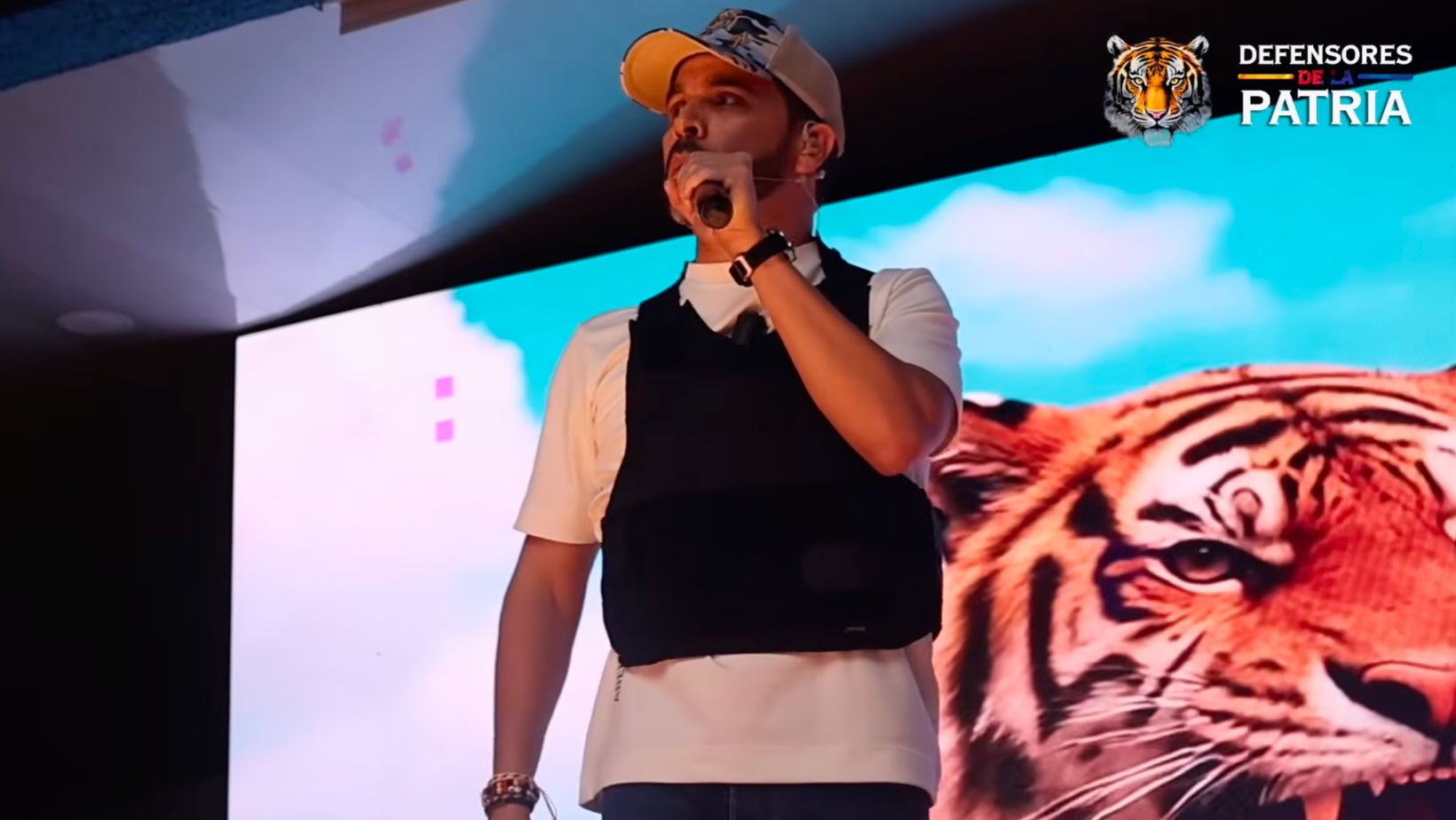
Colombia just closed one of the most turbulent electoral chapters in its recent history. For the first time, the two frontrunners represented opposite ends of the political spectrum with nothing in between. On one side stood Iván Cepeda, a leftist candidate carrying the ideological torch of the outgoing Petro administration. On the other stood Abelardo de la Espriella, a far-right candidate whose entire campaign was built around the concept of “mano dura,” or heavy fist.
And somehow, he won.
Though Colombia has historically leaned right, this level of extremism is new. There was always some gravitational pull toward the center, some acknowledgment of the issues that mattered to all Colombians regardless of party. But this election felt different and the question worth asking is not just how De la Espriella won, but what pushed the country to this point.
Because this was not a vote for De la Espriella. This was a vote against Petro.
What Petro Got Right
Gustavo Petro made history in 2022 as Colombia’s first left-wing president. With that came enormous expectations and enormous scrutiny. His record is genuinely mixed and it deserves to be discussed honestly.
On the social and economic front, real progress was made. The minimum wage increased approximately 39 percent in real terms over four years, nearly 9 percent annually, compared to 0.9 percent annually in the decade prior. Unemployment fell from 12.1 percent in March 2022 to 8.8 percent by March 2026, the lowest level for that month since 2001. Deforestation in the Amazon dropped 54 percent, reaching its lowest point in 23 years. Elderly Colombians, many in rural and impoverished communities, began receiving a monthly stipend of around 230,000 pesos, which for many meant the difference between eating and not eating. These are not small things.
Where Petro Failed
The health sector became a crisis of its own. Medications grew scarce. Clinics and hospitals could not meet the financial demands Petro’s policies created and when institutions cannot pay, they let staff go. What followed was a system stretched beyond its limits, patients waiting longer, treatments delayed and personnel depleted. There are also allegations that some institutions were deliberately withholding medications from patients to make Petro’s government look bad, refusing to dispense treatments until the political tide changed. If true, that is medical negligence of the worst kind. Patients are not bargaining chips and using sick people as leverage in a political dispute is unconscionable regardless of which side of the aisle you stand on.
The labor reforms helped everyday workers but came at a cost to business owners. Tariffs and taxes increased and many businesses closed as a result. The burden fell unevenly and that tension never fully resolved.
The “Paz Total” was his defining foreign policy promise and it became his greatest failure. The negotiations with the ELN and FARC dissidents never produced a ceasefire. The groups did not disarm. They grew. Armed membership increased approximately 50 percent over four years, reaching more than 27,000 insurgents. In 2025 alone, attacks on civilians rose 58 percent and kidnappings increased 133 percent. The ICRC declared it the worst humanitarian situation from the armed conflict in over a decade. Petro himself acknowledged the results were not what he had hoped.
Beyond policy, his personal conduct cost him dearly. He regularly sidelined his own vice president, Francia Márquez, in ways that read as dismissive and condescending toward a Black woman who had broken significant barriers to reach that office. He publicly praised Nicolás Maduro and Daniel Ortega, two of the most repressive leaders in the hemisphere. One thing is diplomacy. Another is admiration and Colombians noticed the difference. Many began to read it as a signal of where his ideological loyalties truly lived and that opened a door to fear about what the country might become.
Politics is about optics. Petro never fully understood that and it cost him and, arguably, cost Cepeda too.
The Assassination That Changed Everything
Then the unimaginable happened. Miguel Uribe, a candidate who had been gaining real traction and who carried the backing of Álvaro Uribe, was assassinated.
The anger that followed was immediate and collective. Because Petro had once been a member of the M-19 guerrilla and because that history was always sitting just beneath the surface of public conversation, the association was made quickly, unfairly and loudly. He has long described himself as a redeemed man. But Colombia holds its trauma tightly. The violence this country endured was not abstract. It was personal. It was generational. It was streets that were not safe to walk. It was children consumed by conflict. It was sounds that never quite left the body.
I was born in Medellín. I know exactly what that memory feels like because I carry it too. I watched violence happen down the street from my home as a little girl. I had family members whose children became sicarios. I grew up hearing gunshots as an ordinary backdrop to daily life. People I love put mattresses against their bedroom walls so bullets would not reach them while they slept. That is not a metaphor. That was real life. Security is not a political talking point for Colombians who lived through that era. It is a wound that never fully closed.
De la Espriella understood how to speak to that wound. After the assassination, he positioned himself as the candidate of order, of safety and of consequences. Half the country heard him.
This is where it is important to be honest. Yes, De la Espriella has defended groups linked to violence as a lawyer. But we do not condemn surgeons for operating on criminals and we should not conflate legal representation with personal endorsement. That argument does not hold.
What does hold is the reality that he is reading from a very specific playbook, the same one used by Nayib Bukele in El Salvador and Javier Milei in Argentina, two leaders who have governed with increasingly authoritarian tendencies dressed in the language of pragmatism and common sense. He has admitted to killing cats as a child. He has made misogynistic comments on record. He has taken positions that contradict basic human rights protections. Still, half the country chose him, not because they believe in him completely, but because the alternative felt like more of what they had already experienced and could not bear to continue.
The Economic Gamble
For those wondering what a De la Espriella government would look like in practice, the blueprint is worth examining closely, with the understanding that many of his proposals remain short on detail about how they would actually be funded or executed.
His plan, developed alongside vice presidential pick José Manuel Restrepo, centers on what he calls a “libertarian economy.” He wants to pressure the financial sector to bring lending rates down to a real 2 percent annually with repayment terms of up to 30 years, and has said he would open the door to foreign banks if domestic institutions refuse to compete. He also promises to eliminate several taxes including the gravamen a los movimientos financieros, known as the 4×1,000, the wealth tax, fuel taxes and the so-called healthy taxes on sugary and ultra-processed products. For businesses, he proposes reducing the corporate tax burden and simplifying the overall tax structure to incentivize investment and formalize more jobs.
His labor model is a significant departure from what Petro built. Rather than the protections introduced under the 2025 labor reform, De la Espriella wants to legalize open hourly work contracts, allowing companies to hire workers strictly for the hours needed without the obligations of a traditional full-time arrangement. He also wants to revisit parafiscal contributions to ease the cost burden on employers. The outgoing government has warned that this model, without full labor rights protections attached, risks deepening precarity for Colombian workers rather than reducing informality as promised.
On state reform, he proposes cutting the public apparatus by 40 percent, eliminating what he calls the “nómina paralela,” the network of parallel payroll and redundant agencies, with projected savings of 25 to 30 trillion pesos. He also proposes creating a Ministry of Family and launching a housing program called “Colombia, país de propietarios,” which would allow Colombians to purchase homes without a down payment on 30-year credit terms.
Some of these proposals, particularly the tax eliminations and lower lending rates, could genuinely benefit everyday Colombians if executed responsibly. The concern is not the direction but the math. He has not fully explained how the government would offset the revenue lost from eliminating multiple taxes while simultaneously funding a 10-trillion-peso health emergency plan, megaprison construction and expanded social programs. The numbers have not been reconciled publicly and that is a problem that will not disappear once he takes office.
The Megaprison Problem
On security, his signature proposal is the construction of megaprisons modeled after El Salvador’s CECOT, the massive detention facility built under Bukele. The concern here is real and worth naming. Reports from El Salvador have documented cases of false positives in CECOT, people detained without sufficient evidence and subjected to conditions that international human rights organizations have flagged as deeply troubling. Colombia has its own painful history with false positives, soldiers who killed civilians and dressed them as combatants to inflate body counts. The hope is that any megaprison model adopted here would be held to a far more rigorous standard of due process than what has been documented in El Salvador. That cannot be an afterthought. It must be a condition.
The Candidate Who Could Have Been
Sergio Fajardo was my candidate. He is a centrist and a former mayor of Medellín who helped transform one of the most violent cities in the world into something the country could recognize with pride. He ran a thoughtful social media campaign and spoke to younger Colombians with clarity and intelligence.
@sergiofajardov Y de paso les muestras mis propuestas 🫰🏼😏 #propuestas #karolg #barranquilla #noticias #novios
But he did not speak loudly enough to everyone else. The messaging landed with millennials and Gen Z but failed to reach the demographics that vote in the largest numbers and with the most conviction in Colombia. He needed to bring in the full country, not just the part that was already listening. He was too measured in a moment that demanded urgency and that cost him the room.
What Actually Won This Election
Cepeda was genuinely prepared to govern. His proposed plan ran over 400 pages. He understood the environment, LGBTQ rights, women’s issues, land reform and diplomacy. He came equipped. But Petro’s shadow never left him. Every time a Colombian saw Cepeda, they saw a continuation and for many that was disqualifying regardless of what Cepeda himself was offering.
The truth is that De la Espriella’s own program of government, the one he submitted for the first round, was a few pages of bullet points. La Silla Vacía and other outlets noted it as a legitimate criticism. The foundation that analyzed his proposals had to pull from his interviews and social media because he had not published a formal plan at the time of review. His health proposal included a 10-trillion-peso plan of action with no explanation of where the money would come from. For the second round he expanded it but the fundamental critique remained: these are aspirational statements, not a governing blueprint.
Desperation won this election. Not De la Espriella. That’s just the reality.
Colombia is now in the hands of a lawyer and entrepreneur with dual citizenship in the United States, no political experience and a governing philosophy borrowed from leaders whose democracies are under serious scrutiny. This is also a man who publicly declared he would leave to Italy if he did not win, which says everything about the level of commitment a leader should bring to the office he is seeking.
But out of the lesser evil, half the country chose De la Espriella and those of us who carry security trauma took a side that is as complicated as it is contradictory to many. These were the cards we were dealt.
Half the country is relieved. Half the country is devastated. The results were almost exactly split down the middle and that divide tells you everything about where Colombia stands right now.
We can only hope that the institutions hold. The courts must remain independent. The press must remain free. The people who showed up in massive numbers to vote, on both sides, must stay engaged and watchful.
Colombia, stay strong. Whatever comes next, we face it together.
For Image credit or remove please email for immediate removal - info@belatina.com